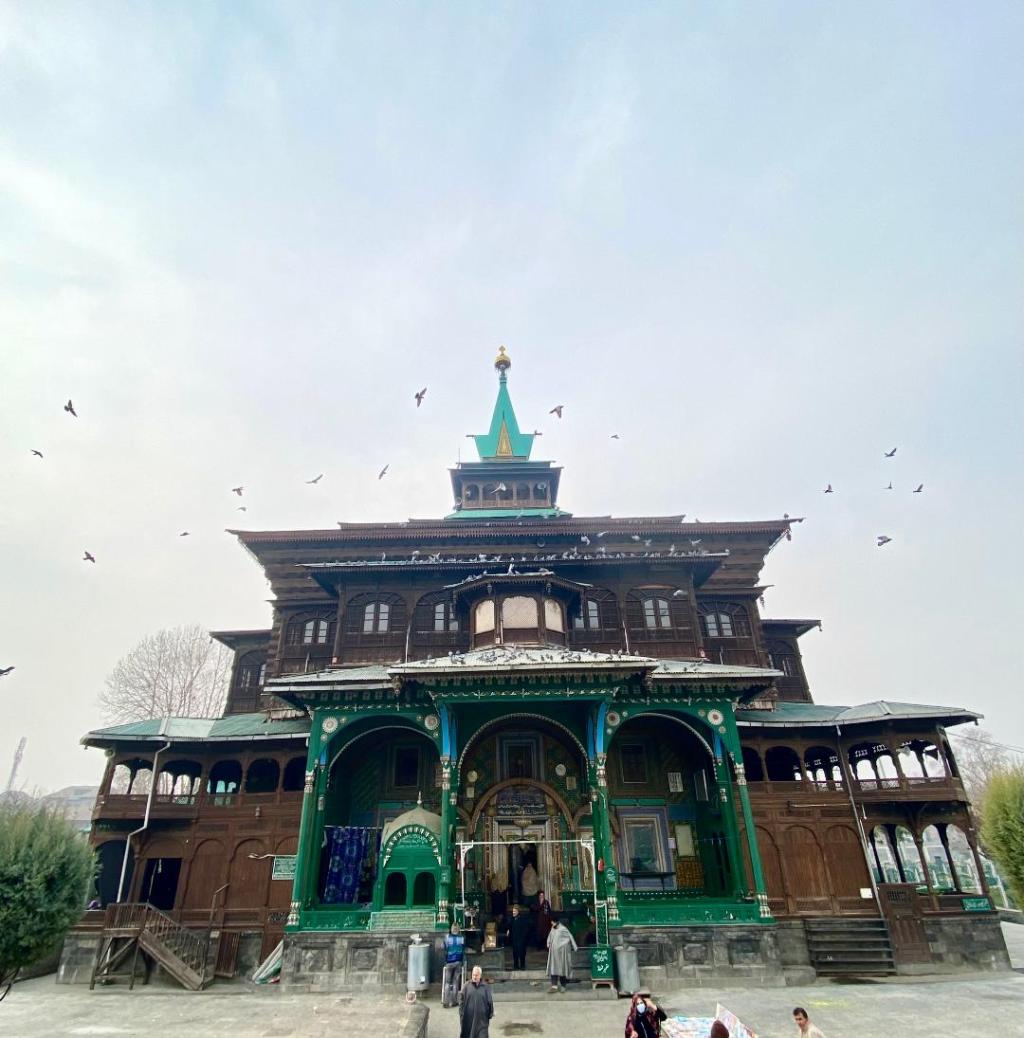
To understand the Kashmir valley today, one must understand the land’s dominant religion and its arrival into the land. Islam, in all its forms, is one of the preeminent forces within Kashmiri culture. This idea of the preeminence of Islam within a culture is accurate to any region where Islam is the dominant religion. Take this quote from Sir Herbert in his work The People of India:
“Islam is a force of the volcanic sort, a burning and integrating force which under favourable conditions may even make a nation. It melts and fuses together a whole series of tribes, and reduces their internal structure to one uniform pattern, in which no survivals of pre-existing usages can be detected. The separate strata disappear; their characteristic fossils are crushed out of recognition; and a solid mass of law and tradition occupies their place” (pg 217).
This quote establishes the reality of the culture-shifting power of Islam; however, it overestimates the scope and severity of the change. Kashmir has other cultural systems that pull a great deal on the values and ideals of the people. However, to Sir Herbert’s point, these are all modified by Islam, or they modify standard Islamic practices. For instance, Sufism, one of the prominent sects of Islam within Kashmir, employs a great deal of syncretism. Islam is intermingled and related in some way to almost every aspect of the Kashmiri life. To detach Islam from Kashmir is to detach bone from muscle.
Since Islam is such a great force for cultural change, one must look to its origins in the Kashmir region to understand what impact it made on the valley. This story begins in the early to mid-8th century A.D. when the Arabs began to push north from the Sind of Pakistan. The then-Hindu Kashmir, with the help of China, was able to fend off the invading Arabs. The Arabs did, however, manage to take China-controlled Gilgit in 751AD (Gilgit is north of Kashmir in present-day Pakistan) (Temple, pg 181). This meant the Muslim Arabs surrounded Kashmir on all sides except for the East, which was occupied by the Chinese Buddhists. While no direct influences can be accounted for during this time, this probably began to influence Kashmir in the middle strata of society. Kashmiri traders, military, and officials would have interacted with these outsiders. However, it is likely that upper-level officials would not have converted for fear of losing their positions. Nevertheless, it should be noted by the late 11th century A.D., there were to be Muslims serving in the Kashmiri military. These Muslims were present in Kashmir before the first Kashmiri Mosque was ever built.
These initial indirect influences of Islam laid the foundation for its true landfall around 1320 AD with the conversion of Rinchan through Bulbul Shah. Rinchan was a Tibetan prince who became ruler over Kashmir. He initiated his reign as a Buddhist; however, before the end of his reign, he converted to Islam and became known as Sultan Sadr-ud-Din. His conversion initiated Muslim Sultanate rule over Kashmir. Rinchan’s conversion came about because of his increasing dissatisfaction with the complexity of Buddhism and Hinduism and his delight in Bulbul Shah’s simplistic faith (Sufi, pg 79-80). Before discussing Bulbul Shah, one should know what ” complexity ” means when discussing Buddhism and Hinduism in Kashmir. Before the advent of Islam in Kashmir, Kashmiri Buddhists and Hindus produced many high scholars of their religion. Shaivism, a Hindu sect, was the prevailing theology of the day. The Trika-Shaivistic scholars of Kashmir had many published works and commentaries discussing the importance of idealistic monism. These scholars wrote extensively on the importance of oneness with the universe and self-realization to find enlightenment or nirvana. This self-realization was to take place through asceticism, and the way of ideal monism was to perform asceticism by conquering one’s physical matter with the power of the mind. This is the exact sort of complexity that King Rinchan would have been privy to. These ideas drove Rinchan to seek answers elsewhere, and he came to Bulbul Shah, where he found the peace of simplicity.
Now, who is Bulbul Shah? Well, he goes by various names depending on who you talk to. Bilal Shah, Bulbul, Sayyid Sharaf-ud-Din, and Sharaf-ud-Din Sayyid Abdur Rahman Turkistani are a few of the ways people refer to him. Bulbul Shah, however, is the most popular name. His disciples gave him this name, who claimed that the mystic, on one occasion, flew in the air to catch a nightingale (Bulbul is the Arabic word for nightingale) (Sajad, pg 63-65). Bulbul was originally from Turkistan but spent much of his time prior to coming to Kashmir in Baghdad, Iraq. In Baghdad, he studied in the Suhrawardi sect of Sufism. A critical note about Sufism is its relative simplicity to Hinduism, Buddhism, and even Orthodox Islam. Most Sufi sects are Sunni rather than Shia, and the Suhrawardi sect is no different. Within Sufism, the object is to gain Barkat (blessings), and this is obtained by simple rituals and a proper mediator. Bulbul would have served as a great mediator in the eyes of Sufism, one for his Sayyid heritage (a Sayyid is a male in the lineage of Muhammed) and two for his claims of miracle-working. A Sayyid with proven power from Allah would have been the ideal candidate for making one’s prayers known to Allah.
Bulbul established the first Mosque and Langar (or Lankar) in Kashmir. A Langar is a kitchen that serves the community. In the Langar, the Sufis would serve many who came for freshly prepared meals. These Langars cared for the poor and sick. Sufis still use these all over India. Bulbul Shah and Rinchan are now buried at Bulbul Lankar in Kashmir. On personal inspection of this place, few Muslims seem to frequent the Lankar, and despite still having the name Lankar, there is no kitchen present. This Langar would have had a great impact on the lower strata of Kashmiri society, while the upper strata would have been deeply impacted by the conversion of Rinchan. With Bulbul Shah’s life and legacy, the finalization of the full advent of Islam into all strata within Kashmir is complete.
At the beginning of this entry, it is stated that the Arab influence in the 8th century A.D. was the foundation of Islam in Kashmir. This metaphor can be drawn out further. Picture a Kashmiri Mosque: The foundation is the Arab influence (8th century), the framing is Bulbul Shah’s ministry (early 14th century), then Sayyid Ali Hamadani and his 700 Sayyids would be the exterior construction and decoration (late 14th century), and orthodoxy and recent Arabization would become the interior walls (20th century). This entry describes just the first two pieces of the metaphorical Mosque. For now, it is important to say simply that Sayyid Hamadani is an essential piece of Kashmiri Islam and arts. Likewise, Orthodox Islam and Arabization are the crucial final pieces of the metaphorical Kashmiri Mosque. These pieces are the most recent addition to the Kashmiri faith and has had an immediate and sharp effect. Sayyid Ali Hamadani and Orthodoxy warrant their own entries and will receive them in time.
`
How has this affected Kashmir today?
My answer to this question is fraught with conjecture and speculation. This should be taken as an opinion that is colored by personal cultural experiences as well as the information discussed in this entry. Nevertheless, here is my best estimation:
First, the Arab failure to invade Kashmir is significant. Kashmir’s independent rule over itself during the advent of Islam meant it could form many styles and practices independently without outside governing control. Furthermore, before Bulbul Shah, the Muslims were without Mosques, and presumably, religious leaders would have been rare. There would have been few to no corrections of folk Islamic practices that strayed too far from orthodoxy. While an outsider, namely Bulbul Shah, presumedly influenced the Kashmiri faith with his cultural nuances, the Kashmiri at large was able to form a local folk Islam. Evidence of this is the Reshi sect of Sufi Islam. The Reshi sect is native and original to Kashmir. Local Sufi mystics of this sect and others arose from within and developed the religion of Kashmir. Foreign rulers would not come till after the primary establishment of Islam in the valley. This means that the pre-existing culture would have a profound impact on Islam practiced within the valley.
Hinduism and Buddhism were sure to leave their mark on the Kashmiri faith. However, Rinchan’s conversion was also likely to have a significant impact. The King’s conversion is almost mythical within Kashmir. Rinchan rejected the complexity of the scholarly and confusing Trika-Shaivism. This sort of idea is indeed captured by Kashmiri Sufism. Kashmiri Sufism rejects the lofty and proud and lifts up humility and simplicity. Still, the impact of Hinduism on Kashmiri mystics can be seen in their acceptance of meditation and asceticism to reach a spiritual state for communing with Allah. Furthermore, Hindus would also leave the love of poetry in Kashmir at large. Poetry is loved and lauded in Kashmir. One can even find tombs with plaques in memory of Muslim poets from bygone eras. New ideas presented in a poetic fashion will likely see more traction in Kashmir than those offered with lofty and formulaic argumentation. Ultimately, the effect of the dominant religions of the past is measured. Some would argue that the Hindu religion has no lasting impact on the Islamic faith of Kashmir, and some might argue that a great deal of the practices of Hindus were holistically adopted by the Sufis of Kashmir. Likely, the reality is somewhere between those two responses. Some practices were syncretized and blended into the new faith of the valley.
The caste system must also be addressed. Islam outwardly rejects the caste system. While Islam began dismantling the strata of caste, it failed to complete the task. Kashmir is left with a new Islamic version of the caste system, albeit less of a hard, fast rule. Nevertheless, it is present and can be seen throughout the valley. A great book that confirms the idea of separate socio-cultural strata amongst the people by a cultural system is Directory of Castes in Kashmir by Dr. Bashir Ahmad Dabla. The theology behind the divisions of people is different, but the divisions remain, nonetheless.
Finally, the surest thing one can know about the advent of Islam within Kashmir and its impact on the culture is that it produced a unique faith. The blending of Kashmiri culture and faith without supervision by outside governmental bodies gave the people freedom of invention. This fact can be witnessed right now in the valley’s many shrines dedicated to their local holy men who fostered this uniqueness.
Works Cited
Risley, Herbert Hope, and William Crooke. The People of India, by Sir Herbert Risley … 2D Edition, Edited by W. Crooke .. W. Thacker, 1915.
Temple, Sir Richard Carnac. The Indian Antiquary. XXXVII–1908, British India Press, 1908.
Risley, Herbert Hope, and William Crooke. The People of India, by Sir Herbert Risley … 2D Edition, Edited by W. Crooke .. W. Thacker, 1915.
Sajad, Abu. Short Biography of Sheik Shafief Ud Din Abdul Rahman Bulbul Shah (R.A.). Sultania Book Depot, 2013.
Dabla, Bashir A. Directory of Castes in Kashmir. Jaykay Books, 2012.

 Threads of Kashmir
Leave a comment