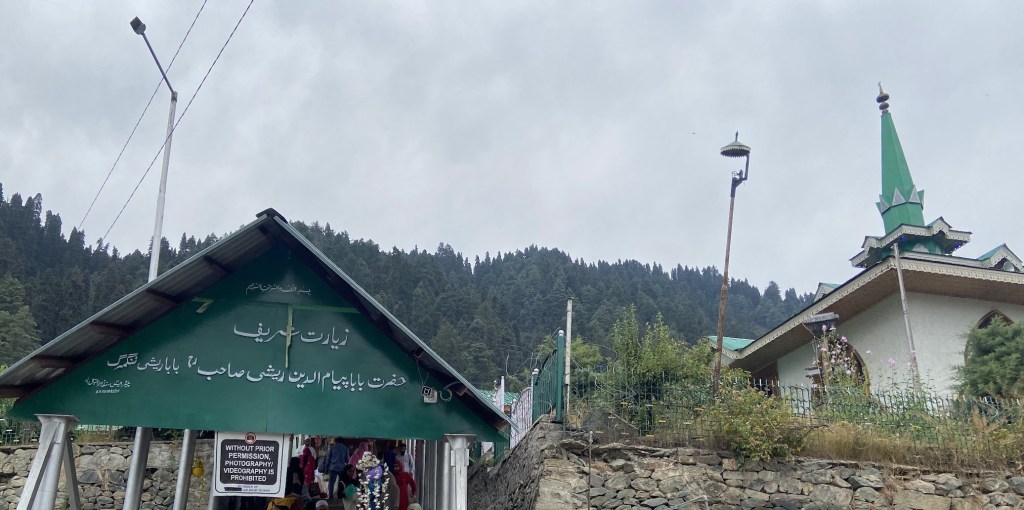
If Kashmir is to be adequately understood, one must balance looking at the past and the present. Looking at the past alone will only lead one to conjecture how past events might have shaped the present reality. However, if these conjectures do not match what may be observed in Kashmir presently, then those ideas do not serve to bring a proper deep understanding of the culture. So, with that in mind, this entry of Threads of Kashmir will discuss the culture of present-day Kashmir in broad strokes. After observing and interpreting the culture broadly, one can begin to dive deeper by analyzing other factors that influence Kashmir, such as its rich history.
In this entry, Kashmiri culture will be discussed using Hofstede’s five dimensions of culture. Each of the five dimensions of culture will be discussed in each of the corresponding sections. To understand another culture, one must compare it to another culture. For instance, one can say that Italian culture is collectivistic due to Italians’ emphasis on family. However, compared to Chinese culture, one would be correct in saying Italian culture is far more individualistic. For this entry, Kashmiri culture will be compared to American culture. Also, it is important to define what I mean by Kashmiri culture. In this short ethnography, when the Kashmiri is referred to, it will be confined to Muslims living in the India-occupied Kashmir valley whose first language is Kashmiri. There are other groups of people living within the Kashmir Valley or from the Kashmir Valley living elsewhere, but those groups are not the subject of this ethnography.
Lastly, as always with ethnographic work, one must generalize for the sake of understanding the larger group. Kashmir is full of individuals that may exist outside of these generalizations.
Identity
Identity reflects how the individual within a culture relates to the group. If individuals within a given society primarily identify themselves as individuals and not as a larger group, then that culture may be said to be individualistic. The opposite end of that spectrum can be described as collectivistic.
How about Kashmir? Where does it lie on the spectrum of identity? Kashmiris are largely collectivistic. This statement could be made for the entire Indian subcontinent and possibly all of Asia, especially in contrast to America. To make this more helpful, Kashmir should be compared to the rest of northern India. Kashmir is more individualistic than northern India. The difference in identity between Kashmir and north India is significant; however, it would seem slight to the average American.
The main reason for this deviation between Kashmir and North India comes down to the caste system. The caste system’s effects and social hierarchies are still alive and well in North India. When Kashmir converted in large numbers to Islam, the caste system began to wane. The remnants of the caste system were fought against significantly in more recent history. This push against the caste system has influenced the Kashmiri.
Now, to be certain, Kashmir is still essentially collectivistic. Again, from the perspective of an American, Kashmiris are almost indistinguishable from North Indians in terms of collectivism. South Asian Islam, for instance, is not without its own version of the caste system. Across South Asia, one will discover that Muslims who make or repair shoes are seen as unclean and distinctly beneath other Muslims. Likewise, Syeds are revered and respected for their lineage, which goes back to the Prophet Mohammed (PBUH). Kashmir is no different. In the Kashmir valley, there are people known as the Watal; these people are known as scavengers and shoemakers. Many other groups will not drink from the same water source as the Watal. The Watals are only one of many of these identifiable groups. Individuals in these groups are identified primarily as a part of their group and not as individuals.
Another significant example of Kashmiri’s collectivistic identity is their view of distinction between themselves and the rest of India. To the Kashmiri he is not Indian he is Kashmiri. There is a pride in being a Kashmiri and a pride in their Valley. The Kashmiri language and traditions are essential parts to who they are. Many know Hindi/Urdu but the Kashmiri language is still an integral part of their identity. This distinction shows the importance of group identity to the Kashmiri.
Family is also a major factor of Kashmiri collectivism. Family is central to the way of life in Kashmir. Unlike in the United States, children often live with their parents well into adulthood. The parents of each household are responsible for finding and arranging marriages for their children. Marriages are also made within a class; for instance, a Syed would never be married to a Watal. Within villages, children will often learn about the family trade. If the father is a baker, then the son will likely be a baker as well. Again, this significance placed on the family aligns with the idea that Kashmiris primarily identify as a collective.
Lastly, within Islam is a strong brotherhood and unity between spiritual brothers can be noted. Kashmiris also enjoy a broad family within their Islamic fellowships.
These paradigms within the Kashmiri zeitgeist show how identity within their society is determined. At this point, it may be helpful to give a hypothetical order to how a Kashmiri might perceive himself and compare that to an American. A Kashmiri Ghad Hanj (a lower class of Kashmiri fisherman) might identify this way (in order of priority from most important to least): Kashmiri, Muslim, Ghad Hanj, Son, Husband, fisherman, educated, boat owner, and successful. An American fisherman may identify this way: A successful fisherman, a fan of the Atlanta Braves, a husband, an American, and a son. These examples will not perfectly illustrate many individuals within both groups, but they are helpful for comparison. The Kashmiri will identify primarily with the groups he is a part of, only later to identify with personal accomplishments, while an American will start by identifying what is unique and different about him as an individual.
Hierarchy
Hierarchy deals with power distance. The power distance is how a given society divides itself in terms of social power. In particular, hierarchy deals with vertical stratification as opposed to horizontal. The spectrum of hierarchy spans from low power distance to high power distance. In a low power distance culture, there will be little difference in the treatment of individuals and groups along differing vertical strata. For example, a congressman standing in line with everyone else to pick up his medicine at a pharmacy is an example of a low power distance. While a congressman being recognized and brought to the front of the line is an example of high-power distance. Power distance is perceived by behaviors and treatments given to those of elevated status. However, power distance is internalized; the behaviors come from what is felt and believed. So, the ethnographer is left to interpret behavior.
Kashmir, when compared to the West, has a high power distance. Much of the discussion about the caste system belongs here also. The caste system and its Kashmiri version are examples of high power distance. Within the family, patriarchs have a significant social power over the rest of the family. While in the West, parents do have significant power over their children, it does not compare to Kashmir. In America, if an adult son breaks from the values of the family, he may be kicked out of the house or ostracized by the family. However, due to Western individualism and independence, the son will likely be able to find other ways to provide and sustain himself. However, in Kashmir, children will stay with their parents well into adulthood, and their society is designed for that. So, when an adult son is disowned, they will lose livelihood and basic provisions with little recourse. Not only that, but society at large will likely take the side of the patriarchs.
Also, in the Valley, there are many divisions that form the larger hierarchy of society. These divisions will be discussed in future entries. For now, it is important to state that between these various levels of hierarchy, there are large gaps of power. For instance, many will not drink from the same source of water as Watal. This demonstrates a more significant desire for the upper castes to distance themselves from the Watal. These social acts demonstrate the apparent limitations placed on Watal. The Watal, therefore, do not enjoy the same opportunities that others have.
As far as employment is concerned, the power distance between the boss and the employee is severe. There is no Human Resources in Kashmir. While there are exceptions, in general, if an employee is mistreated by their boss, there is little that can be done for it. Employees often look more like servants; this is not to say that they are not paid even well sometimes. However, there is often no real job description, and the employee just does whatever the boss asks of him. Generally, there are two jobs: boss and worker. In some larger businesses, you may have three employees: boss, middle manager, and worker.
Lastly, Kashmir is trending progressively towards low power distance. The young people of Kashmir often resent the power dynamics in the Valley. Many youths are learning about secular and Western ideas, and many of them find these ideas attractive.
Gender
Gender as a dimension of culture falls on a spectrum between Masculine and Feminine. According to this dimension of culture, if a society values assertiveness, competition, and strong gender roles, then that society is more masculine. Likewise, if a society values gentleness, cooperation, and a lack of gender roles, they would trend towards Feminine. However, for Kashmir, these ways of analyzing this dimension are not helpful. Here, the discussion will not determine the overall Masculinity of Kashmir. Instead, we will look at individual characteristics that deal with these gender-oriented values.
First, the gender roles in Kashmir are deeply held. The Kashmiri Muslim holds to traditional Islamic gender traditions. The men of the family are supposed to lead and protect their family. It is also their job to make sure that the family is properly following Allah. This means that the fathers make sure that the men go to the mosque and the women are modest. Even at the mosque or shrine, there are separate places for the men and women to worship. More gender roles will be covered in future entries. For now, it is sufficient to know that Kashmiri gender roles are far deeper and more strongly held than those roles in the West.
Second, the spectrum of assertiveness and gentleness is challenging to address fully. In some ways, America is far more assertive in terms of directness. However, in other ways, the opposite is true. For instance, in Kashmir, with some investigation, one can find that many fathers and husbands beat their wives and children when they fail to behave appropriately. Also, protests that are highly critical of the government and political figures are relatively common in the Valley. At the same time, foreigners will see that the average Kashmiri is indirect, even to the point of lying to ensure that they will not offend you.
Lastly, Kashmiris are deeply hospitable. Often, at the first meeting, a Kashmiri will invite the foreigner to their home and feed them. Even those in poverty will go and buy food that is not affordable to provide a memorable meal for their guest. While on many other spectrums, Kashmir tends towards cultural masculinity, in this way, they tend towards femininity.
Truth
The truth dimension of culture is uncertainty avoidance or uncertainty tolerance. An uncertainty-avoidant culture seeks to eliminate uncertainty. This appears in a culture with abundant strict laws or moral codes that determine behavior and how to deal with every possible scenario. An uncertainty-avoidant culture will also have little tolerance for lying and stretching the truth. Uncertainty-tolerant cultures are far more lenient with lying. Also, laws and moral codes will be held looser and can be bent. It should be stated at this point that no culture is entirely one way or another. The most uncertainty-tolerant culture still punishes certain abhorrent acts, clearly demonstrating some moral codes that may not be broken.
Kashmir is far more uncertainty-tolerant than America. All of South Asia is far more tolerant of uncertainty than much of the Western world. Even within South Asia, the Kashmiri is known for being prone to telling lies and exaggerating the truth. It is common in South Asia for taxi drivers to say that they know how to get to a particular location, only to pull over and ask how to get to that same location later. At the same time, taxi drivers may also run red lights, lane split with a van, and drive in the wrong direction on a one-way road. An American in Kashmir will often feel like there are no rules to be followed. Many will think that the Kashmiri society is totally chaotic, and that simply is not true. There are people and things that can be trusted as true and rules that govern social and societal interactions. Those rules are more flexible and situational, and this is what leads outsiders to believe there are no rules.
Lastly, one way to understand lying in the Kashmiri culture is to understand that truth is valued as less important than feelings, providing for one’s family, and saving face. If the foreigner asks a Kashmiri if they know where something is, they will feel like pressure to say yes because they do not want to seem unhelpful or foolish. With that in mind, foreigners can better understand how to relate to and interpret what they hear.
Virtue
This dimension of culture seems like a misnomer; it is not about some level of righteousness but about long-term versus short-term orientation. A long-term-oriented culture like Japan values behaviors that produce long-term benefits that last for generations, while extremely short-term-oriented cultures will value frugal and quick fixes that get the job done but may not last for much time at all. Short-term-oriented cultures prioritizes the here and now often because it is felt necessary for survival. While, long-term-oriented cultures prioritizes building something sustainable at the expense of the present.
Kashmir, in comparison to America, is short-term oriented. One example of this is a Kashmiri apple seller who will push his cart further into the street to catch more attention, sell more apples, and provide for his family today. This is widely done and has been formed as a cultural trait, and because of this, it has created a long-term problem of increased traffic due to usable road narrowing. Another example can be found in the practice of lying. Kashmiri salesmen are prone to lying to make a sale; this solves short-term problems while lacking the long-term oriented value of customer-seller trust and loyalty. Lastly, saving money is not a virtue in Kashmir. Some will even see saving money as greedy and selfish. To the Kashmiri, provision for the present is far more important than building and prioritizing what may come in the future. The history of Kashmir is at play here. The valley has seen turbulence for many years, demonstrating uncertainty about the future. This led to a culture that does not have faith in the future.
Note: This entry lacks citations on purpose. These ideas are personal observations. This is because all of these dimensions can only be understood in comparison to other cultures. Many people from all over have written about Kashmir and its culture. I would have to have a sufficient understanding of the culture of the author, both of his society and his time, and that is a challenging endeavor. Therefore, the analysis of Kashmir in this entry is not definitive and should be used to provide a very broad understanding of the Valley.
Other entries will discuss nuances and specific aspects of the Kashmiri culture.

 Threads of Kashmir
Leave a comment