Overview
This entry of Threads of Kashmir will discuss the next prominent figure in the development of Islam within Kashmir. Sayyid Ali Hamadani, also known as Shah-i-Hamadani, is likely the most notable figure in Islam in Kashmir. He was born in Hamadan of the Ilkhanate Empire (present-day Iran) in 1314 AD. He was trained by two Pirs (Sufi religious leaders), Shaikh Abu’I Barakat Taqi-ud-Din Ali Dusti and Shaikh Sharaf-ud-Din Mahmud Muzdaqani (Sufi, 83). This training was done within the Kubravi Silsila (Order). The Kubravi is a sect of Sufism, a branch of the Suhrawardi Silsila (Rafiqi, 87). In his later studies, Sayyid Ali was instructed to travel and learn from many Sufi Pirs around Central Asia. Travel like this is common amongst all Sufi orders, but it is particularly common in the Kubravi order (Rafiqi, 92).
There is debate about why Sayyid Ali left Central Asia to come to Kashmir. The most common theory is that he was fleeing from Timur (a powerful Central Asian ruler), while others make the argument that he came to Kashmir strictly for religious work. Either way, historians agree that he first sent two of his cousins, Sayyid Taju’d-Din and Sayyid Husain, to see if Kashmir was ready for Islamic missionary efforts (Rafiqi, 93). Again, there is a debate about how many visits he made to Kashmir. There is very little evidence of any assertion, but the common thought is that he visited and left 1-3 times. Personally, I do not think that the arguments here matter, nor do they have solid evidence for any perspective. When Sayyid Ali came to Kashmir, he was said to have brought 700 followers (Sufi, 83). The time Sayyid Ali spent in Kashmir was approximately 1372-1385. Sayyid Ali died in 1385 on his way out of the Kashmir valley; he was then buried in Khatlan in present-day Tajistan (Rafiqi, 95). During his stay in Kashmir, Sayyid Ali had a profound impact on Kashmiri culture, both spiritually and materially. Through his efforts, the valley of Kashmir was dominated by the Islamic faith. In addition to his 700 followers, he brought many artisans. He taught the Kashmiris a great deal of the Persian crafts and arts, and through his teachings, he incorporated many Persian and Arabic words into Kashmiri (Mufti, 43-44).
Preaching Methods
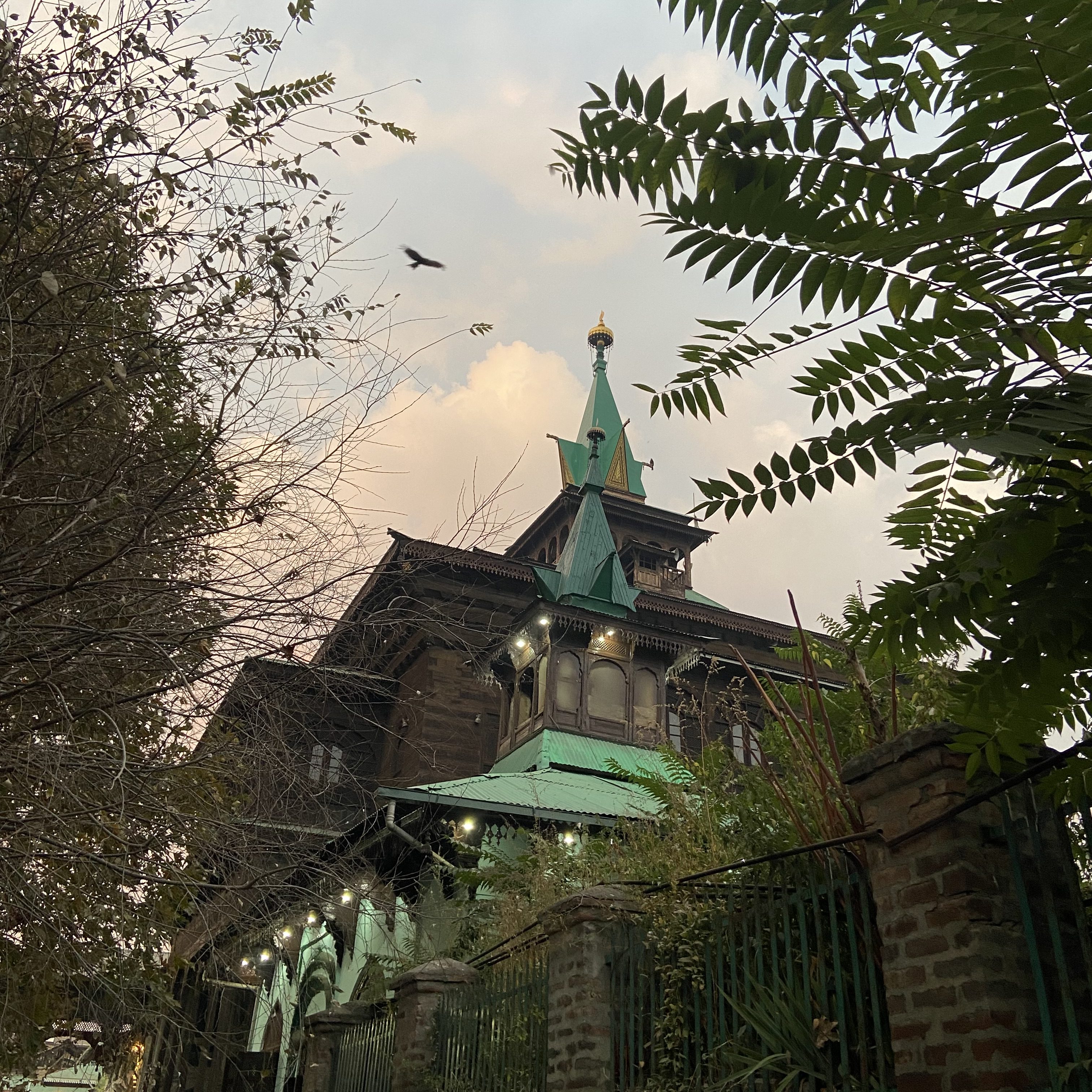
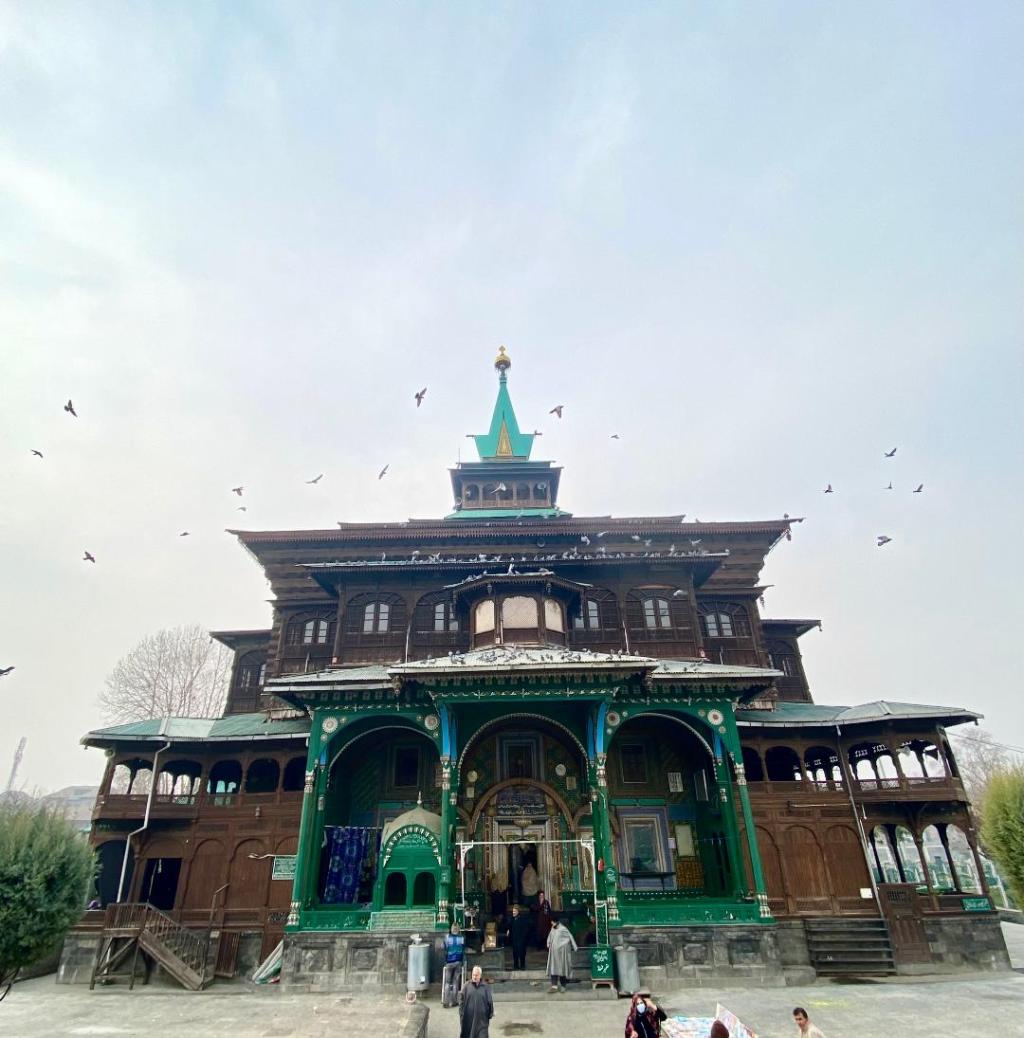
Possibly the most notable physical contribution to the Valley of Kashmir is the building of Khanqah-i-Moalla, located in Srinagar. He built several khanqahs, and his followers built several more throughout the Valley. According to Dr. Gulzar Mufti, the word Khanqah simply means “a holy place of worship” (Mufti, 20). While that may be an easy translation, it lacks the complexity necessary for complete comprehension, as one might use the same definition for a mosque. However, historically, they could likely be more closely compared to Christian Monasteries. The Khanqahs served as places for study and deep contemplation of the Quran and Allah. They were built in such a way as to facilitate quiet, tranquil meditation. This may have been a source of interest for Kashmiri converts to Islam from Buddhist and Hindu faiths, which are also rich in this sort of meditation. However, for Sayyid Ali and his followers, these Khanqahs served as centers for proselytization and teaching. According to Abdul Rafiqi, Sayyid Ali would visit and build Khanqahs in locations known for being “great Hindu centers” (Rafiqi, 97).
There is some disagreement about Sayyid Ali’s use of miracles for the sake of proselytizing. There is a common story that Sayyid Ali ordered his disciple to show the power of Allah and put a Hindu Brahman to shame. The disciple supposedly had his shoes fly through the air and beat the Brahman on the head. However, others disagree, saying that Sufi thought was that Islam should be spread not on miracles alone (Rafiqi, 96). However, the fact of history hardly matters; the current reality is that many (if not most) Kashmiris believe Sufis like Sayyid Ali Hamadani were doing miracles regularly.
The spread of religious thought by Sayyid Ali was not only accomplished through word of mouth but also through written works. His writings were written in the form of letters. The letters follow traditions common to other Sufis of the time (Rafiqi, 101). A good comparison might be letters written by Apostles in the Christian Bible. Likely his most famous and important literary work is Zakhirat-ul-Muluk. Zakhirat-ul-Muluk is meant to guide rulers in just governance (Mufti, 40).
Theological and Political Thoughts
The content of these letters provides insight into the specific aspects of Sayyid Ali’s teachings. Sayyid Ali Hamadani believed that for government officials to lead justly, they ought to enforce the Islamic Sharia (Islamic religious law). He desired for Islamic law to govern Kashmir; however, the ruler at the time did not satisfy the wishes of Sayyid Ali, which prompted his leaving Kashmir. However, Sayyid Ali’s son, Mir Muhammad Hamadani, had more success in this regard. Sayyid Ali had the understanding that implementing Sharia would be a great kindness to the people and instructed rulers to govern fairly. To the Sayyid, a leader should not use fear to rule over the people (Rafiqi, 136-144).
An entire entry of this blog could be dedicated to the theology of Sayyid Ali Hamadani and the Kubravi Order of Sufism. However, for now, a quick overview will suffice. Sayyid Ali split faithful Muslims into several categories. For the sake of simplicity, we will discuss the three main groupings: the common lay people (‘am), the elect or scholars of Islam (khas), and the elite and most special among the faithful (akhas) (Rafiqi, 120). Sayyid Ali, in his many letters, makes several divisions for discussing similar levels of hierarchy within Sufism. Each way of dividing people is subtly different in scope. However, I will try to capture the main ideas within these divisions. First, the ‘am are the ordinary lay people. Sayyid Ali does not expect much from these people other than basic following of the pillars of Islam. The Khas are the devoted followers of Islam who belong to the ‘ulama (scholars of Islamic law and theology). They are those who teach the ‘am and help Muslims follow the fundamental pillars of Islam. To Sayyid Ali, while the pillars of Islam are essential, they are simply the beginning of the knowledge of Allah. To him, they are essential but basic. The akhas have moved past these pillars into deeper understandings of their faith. The akhas still practice the five pillars of Islam, but for each pillar, there is a deeper understanding for the akhas. They are not to be bound to the world or desire the things of the world. They practice mystic meditation rituals that are designed to produce more profound understanding of Allah, a greater cognition or knowledge (‘ilm). This is the great pursuit and ambition for the akhas. They desire to know Allah to the limit in which they are able. For Sayyid Ali, these people are chosen by Allah to receive special understanding; to him, not all who desire this knowledge are able to receive it. The end goal is annihilation (fana). For the Sufi to reach fana, he meditates with intense zeal for knowledge of Allah that he merges with Allah, and the Sufi’s knowledge of self dissolves, with only cognition of Allah remaining (Rafiqi, 108). In the path of meditation that leads to fana, the Sayyid explains that one must rid their desires of anything other than Allah. To Sayyid Ali, the fasting of Ramadan and the giving of alms (zakat) were the beginning of this deeper path.
Much more goes into these concepts and ideas, but through this overview, one can see the main ideas and themes of Sayyid Ali’s theology. He was passionate about instilling what he considered justice into the ruling class of his time. He pursued knowledge of Allah and desired to lead a special class of Muslims into greater understanding. This understanding or cognition did not come from the Quran and Hadiths. While basic cognition of Allah came from the Quran, for the akhas, deeper understanding came from deep devotion to meditation and ascetism.
Kashmir Today
Here I will speculate what effect Sayyid Ali Hamadani had on Kashmir that still holds to the present day. There is no doubt that Sayyid Ali Hamadani had a massive impact on the people of Kashmir; he is the reason why Kashmir is majority Muslim. His establishment of Khanqah and bringing 700 other teachers with him was his main way of impacting Kashmir with Islam. These Khanqahs still hold much sway over many of the common people of Kashmir. They often seek these places out as sacred places where they will have a better chance of being heard by Allah. The Sayyids’ distinctions and hierarchies of Islam likely impacted the Kashmiris. I think that the average Kashmiri sees the same distinction between the common layperson and the special class of Muslims who teach them. For the average Muslim, they should simply practice the five pillars of Islam to the best of their ability and overall be a good person. This, in their mind, is sufficient to enter Jannat (paradise). In contrast, the teacher obtains higher enlightenment. Through these distinctions, the average Muslim of Kashmir denies any ability in himself to make a confident assertion of Allah. They can only repeat what the learned ones who have obtained greater cognition say. Likewise, the religious practices of the ‘am may be sufficient in their mind for Jannat. However, if they are to receive barkat (blessings) in this life, they will likely seek the barkat that comes from the akhas (special followers of Islam). This includes those who are already dead. Because of that understanding, these Khanqahs grant them more blessings for being connected to an akhas of high stature like Sayyid Hamadani. These ideas are likely in the minds of many Kashmiris but will be especially true in the minds of Sufi Muslims and the less educated. More educated minds in Kashmir will revere Sayyid Ali, but they will emphasize his desire for justice and his commitment to Sharia and the five pillars of Islam. They will also credit him for the cultural contributions to Kashmir, such as the arts and language.
Works Cited
Sufi, G. M. D. Kashir: Being a History of Kashmir: From the Earliest Times to Our Own. Gulshan Books Kashmir, 2015.
Rafiqi, Abdul Qaiyum. Sufism in Kashmir. Gulshan Books Kashmir, 2015.
Mufti, Gulzar. Shah-i-Hamdan & Khanqah-i-Moalla. Ali Mohammed & Sons Publishers, 2014.

 Threads of Kashmir
Leave a comment