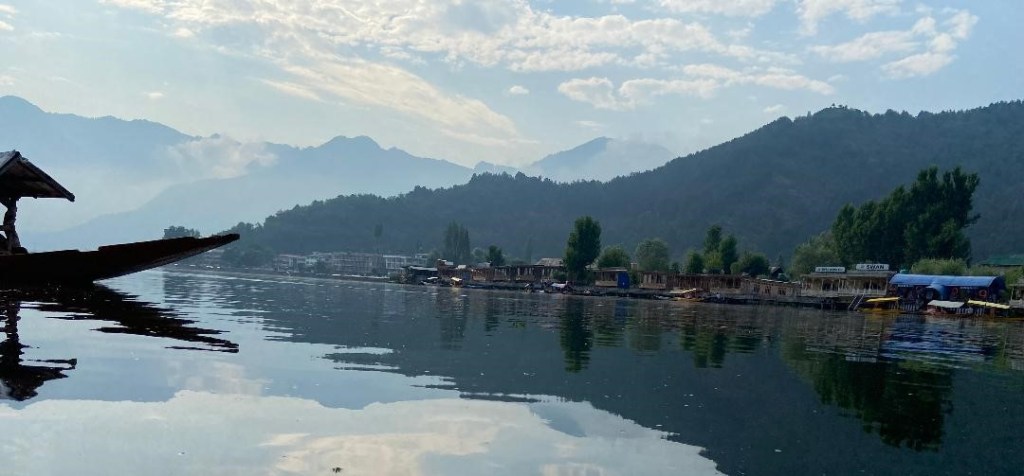
This entry in Threads of Kashmir is meant to be an introduction to Kashmir and what may be experienced on your first trip. More details about the people, places, and ideas in this entry will be expounded on in future articles. This entry is written with a fictional but realistic story of a traveler’s first time to Kashmir. This is written in bold. After each section in bold is a description of the things discussed in the story. This will hopefully provide meaning to the information being delivered and a context for why these facts would be valuable for a traveler to Kashmir.
As a first-time traveler to Kashmir, you step off the plane and eagerly go to grab your bags. But before you get there, you encounter an FRO officer. He stops you and asks you to follow him to fill out paperwork. You petition him that you wish to get your bags first. He denied your request, and you hurriedly filled out paperwork asking where you came from, about your visa, and where you would be in Kashmir. You finish and quickly go to the baggage claim, and your bag is on the ground… Why? Who put it there? These questions remain unanswered as you venture out of the Airport into Srinagar, the capital. You are then met, almost confronted, by a soldier asking you where you are headed. You tell him, and he walks you to the taxi stand, where you get your ride and settle in. As you ride to your houseboat on Dal Lake, you begin to take in everything you are seeing. You see many soldiers and their tactical vehicles. You may begin to wonder if it is safe to be here. You then start seeing all sorts of buildings and people utterly foreign to you. You just came from Delhi, and things don’t even seem similar in that city. Then you see what might be a river or canal, and you turn… there it is… Dal Lake! It’s busy, but it’s beautiful. The mountains on the opposite side of the lake feel as though they come straight out of the lake. The taxi “Wala” lets you out by some sort of dock where you get a ride on a “shikara” boat to your houseboat. The ride is tranquil, and you begin to feel the restfulness you expected from the trip. Your host greets you with a big smile, welcomes you into the boat, and shows you the room. You put your things down and go onto the front of the boat to sit. While you drink the Kahwa your host brought out, you think, “I’m finally here!”
When arriving at Srinagar airport, there is a Foreign Registration Office (FRO). Their main goal is to keep you safe. Expect calls to the hotel you intend to stay at, ensuring you are there. I once changed my mind about hotels after leaving the airport, and an FRO officer came looking for me. I also had to change my mindset about seeing all of the military. At some point, I realized that the militants or extremists I heard about on the news are not some tremendous force; they attack places with less of a military presence. It is also rare for attacks to be in places of tourist interest. I began to feel safer around the soldiers. On the way to Dal Lake, you will see the river Jhelum and a small canal. From a less touristy perspective, the Jhelum River, originates in the southeastern part of Kashmir, then flows north to Srinagar, at which point it flows west and out of the valley by way of Baramulla (Bates, p9). The Jhelum and its tributaries are essential parts of the valley’s agriculture. It is understood that Kashmir lives and dies by the Jhelum. Years before the national highway and the abundance of automobiles in the valley, the Jhelum was used to transport people and cargo around the valley (p 10). The Jhelum also pours into the largest lake in Kashmir, Wular, located just outside Sopore. Wular gets very little attention from tourists, unlike Dal Lake in Srinagar. On Dal Lake, tourists enjoy houseboats, and Shikara rides through the floating market. The people who do boat rides and manage houseboats are called Hanji. Many Hanji people also live in almost swamp-like parts of Dal Lake. They live on or near the water throughout Kashmir, whose livelihood depends on fishing, aquaculture, and water-bound tourism. My time spent on Dal Lake is some of the most restful times in the valley. Truly tranquil experiences. Kahwa (Kah-va) is a type of tea most commonly served to tourists. It is sweet and has several ingredients in the brewing process, often accompanied by saffron! However, the tea favored by locals is noon chai or salty tea. It is made like normal sweet chai, but it also has salt and baking soda. For most travelers from the West, this will be difficult to enjoy! From a conversation with a local, I was told that Kahwa was traditionally given to guests to welcome them in days gone by. This may explain why Kahwa is now exclusively given to tourists.
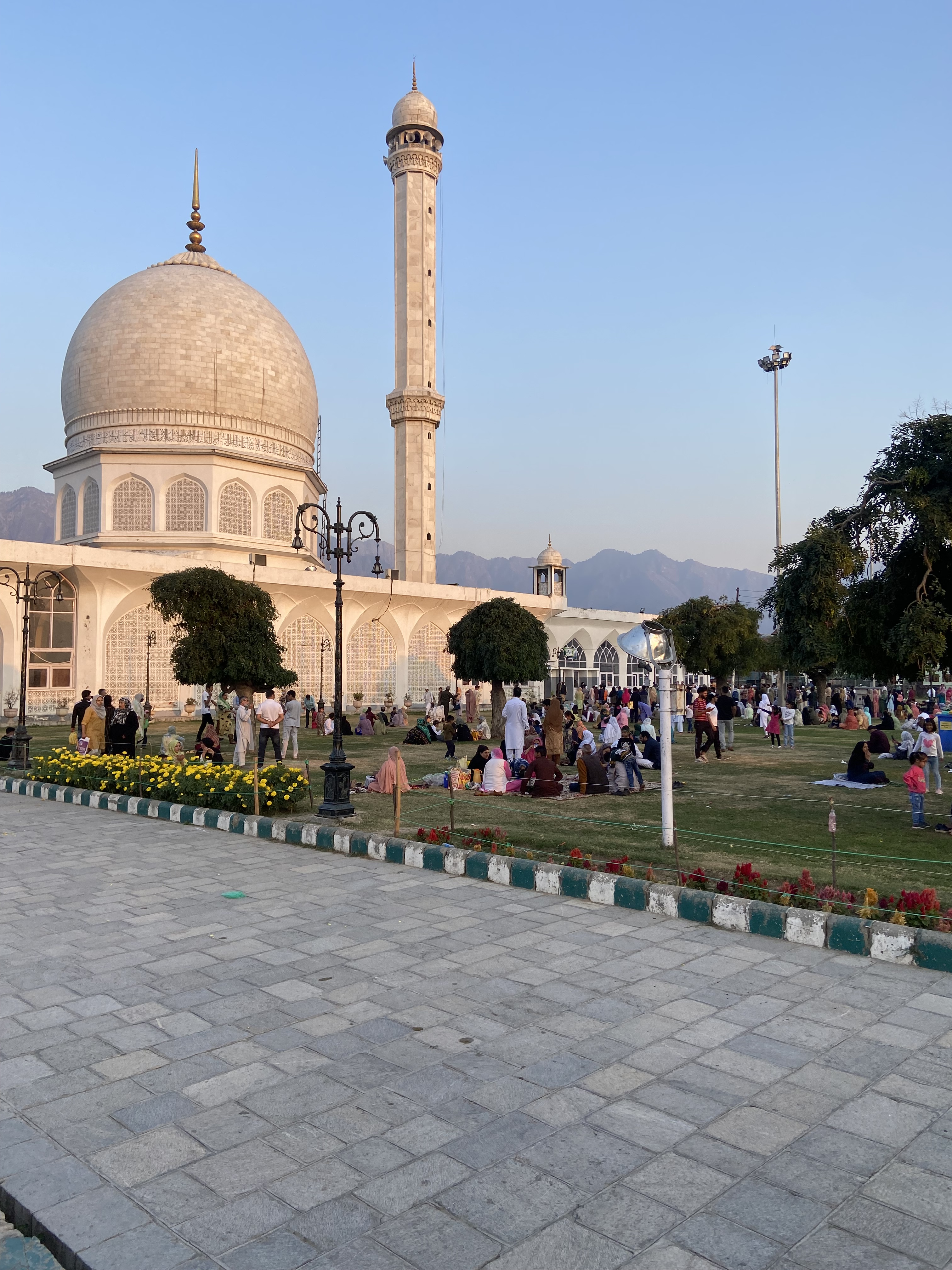
You spend much of the following day fascinated with the floating market and the scenery surrounding Dal Lake. After visiting one of the many famous flower gardens of Srinagar, you see across Dal Lake, what appears to be a large Mosque. You ask a local about it, and they tell you that it is Dargah Hazratbal. So the following day, you take a taxi to see this Dargah. After many conversations with those at the shrine, you learn what a Dargah is and that there are many in Srinagar and even many more in Kashmir at large.
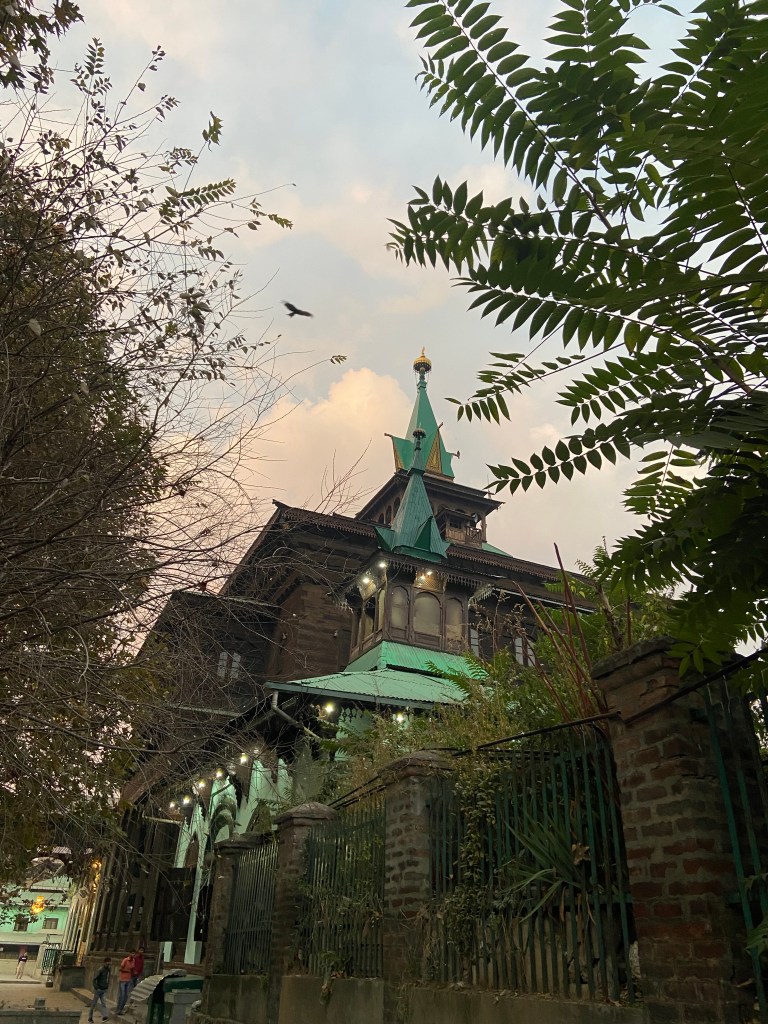
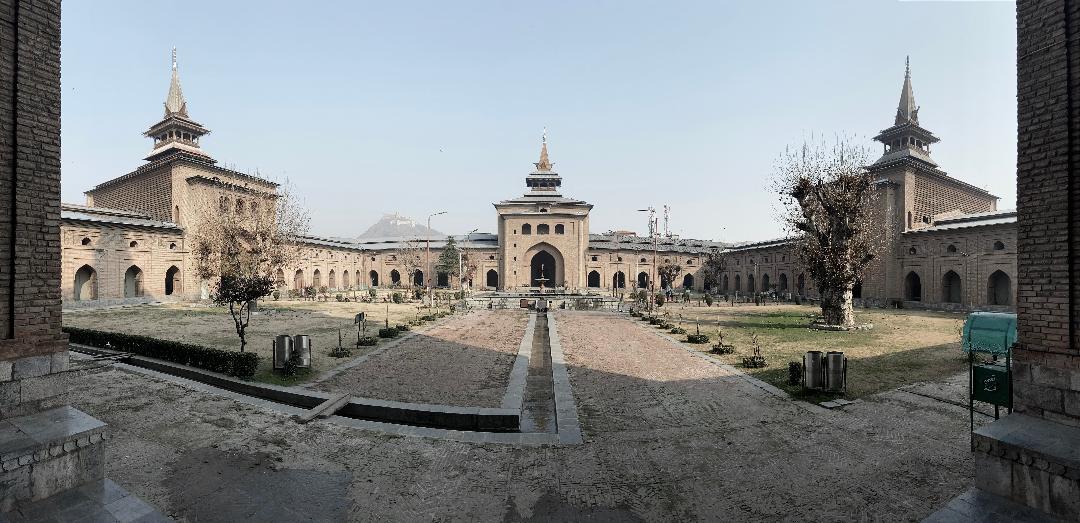
The floating market is a set of shops that sell all sorts of handicrafts, dried fruits, and saffron. Flower gardens surround Dal Lake. The tulip garden is likely the most famous of all of them; however, it is only open from March to May and is full of people the entire time. People traveling to Kashmir will likely first notice the beautiful scenery. Still, shortly after, they will notice the local Islamic Mosques and Ziyarats (aka Dargahs) like Dargah Hazratbal. Great artistry and thought went into the creation of these buildings. Many are built with a high level of craftsmanship and contribute to the beauty of the valley. While Mosques are common to much of the world, Ziyarats are a more common feature of South Asian Islam. These shrines originate in Sufism, a sect of Islam that is predominately found in South Asia today. Kashmir, too, is full of these Sufi shrines. Dargah Hazratbal is possibly the most famous of these Kashmiri Ziyarats. Hazratbal, according to local lore, has a beard hair of the Prophet Mohammed. Dargah Hazratbal is important to the Kashmiris, but its architecture is clearly more Arab than Kashmiri. Other shrines like Khanqah-e-moula bear a more Kashmiri style architecture. Anyone who looks at photos of these two shrines can clearly understand the differences I am talking about. Sufism is a mystical sect of predominantly Sunni Muslims. While in Kashmir, there does exist a small sect of Sufis that are Shia called Noorbakshia. Sunni Islam is the prevailing faith of Kashmiris, with Shias coming in second.
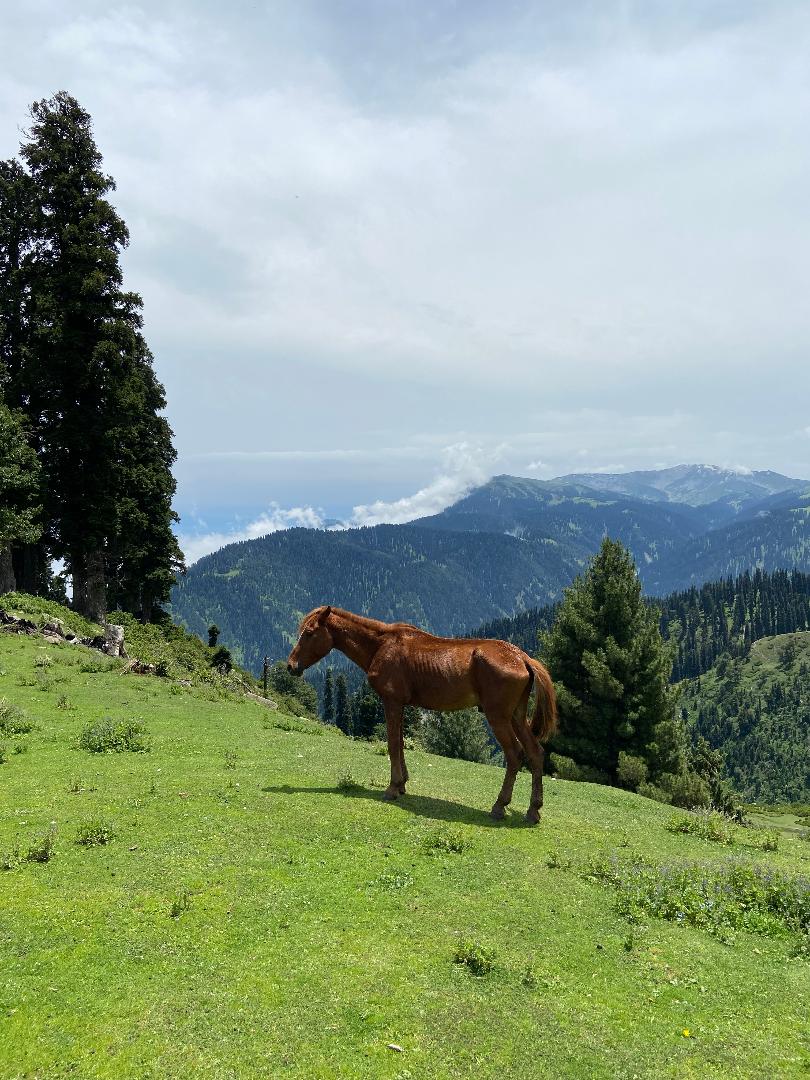
After a few days in the capital, you planned to see Gulmarg in the Pir Panjal range. As well as Pahalgam on the side of the Himalayas. On the way to both places, you see military convoys pass and bunkers commonly along your route. You also see many shops offering dried fruits and saffron. Finally, once you are out of the city, you see many farms and orchards! Once you arrive in Gulmarg and Pahalgam, you encounter people who ask you if you want to ride a horse. Then you meet more of them, and then you meet more of them. Finally, you relent and agree to take a horse on a trip. You realize that horse might be a strong word for these animals that are no more than malnourished ponies. But your time in both places is captivating! You hear of a local saying “Kashmir Jannat hai”, which means Kashmir is paradise, and it may look good enough to be paradise. During these trips, you spend time talking to locals who are visiting these places, and they tell you how you should go to many other places. They mention Doodhpatri, Shrunz, Aharbal, Sonamarg, and many more.
Kashmir is situated between the Himalayas on the northeastern side and the Pir Panjal mountain range on the southwestern side. The area of Kashmir is 6,131 square miles (Sufi, p8). For comparison, that is about 600 square miles larger than Connecticut. Within the valley itself, there are only a few large hills of importance. Much of the valley consists of small, rolling hills and flat cropland. Hari Parbat and Charar-i-Sharief are two of these important eminences. Hari Parbat is a large hill in Srinagar with a fort atop it. This fort has a great view of Srinagar and Dal Lake. Charari-i-Sharief is a large hill with a tomb of a local mystic (aka a Ziyarat or Dargah). As for the tallest mountain belonging to Kashmir, that would be Kolahoi, which is 17,799 ft, which is just short of Kilimanjaro at 19,341 ft. Along the Pir Panjal range stands the world-famous Gulmarg, a beautiful resort village; Doodhpathri (pronounced Dude+pot+tree), a scenic meadow and creek placed high in the mountains; and Aharbal and Shrunz, a couple of waterfalls primarily visited by locals (Aharbal in the South and Shrunz in the North). Pahalgam is a tourist village in the Himalayas. Pahalgam means village of shepherds. Sonamarg is also placed within the Himalayas. In all of these places, you can find features like glaciers, rivers, streams, elevated meadows, and beautiful flowers. Those who take care of the ponies are called Galwan. HOWEVER, please know that I have had a conversation with a local who said it would be rude to call them by the term Galwan. Depending on what you read, some negative or positive stereotypes are attached to that name.
Finally, you journey back to Srinagar for the last bit of your journey. And on your way back, your taxi driver asked if you had Wazwan yet. You have never heard about Wazwan until now. Hearing this, your driver insists that you must go to the Mughal Darbar and have Wazwan, the Kashmiri specialty dishes. So, you go and have your fill; you were glad to experience it before you left.
Wazwan isn’t just one dish but rather an assortment of various meat dishes that are served alongside a large mound of rice. Wazwan includes various kebabs, curries, and quarmas. During weddings and other special events, it is traditional for Kashmiris to eat Wazwan. Wealthy Kashmiris will hire Waza (the people who make Wazwan) to come to their home or the event and prepare the feast. My favorite of these is merchi quarma, which is a spicy lamb dish. The local’s favorite part of Wazwan is a lamb meatball known as Rista. As with most Kashmiri cuisine, Wazwan is served on a bed of rice. While most of North India’s carbohydrate of choice is bread in the form of roti and naan, Kashmir most commonly uses rice instead of bread. The lack of roti at meals is not to say bread isn’t an important part of the culture. Local Kashmiri bakers are found in every village and in almost every neighborhood. These bakers produce all sorts of tasty breads, from Lavassa and Girda made in the morning and kulcha in the afternoon. These breads are eaten for breakfast and during morning and afternoon chai breaks. Also, Kashmiri cuisine is also dominated by meat or “nonveg,” which is also in contrast to North India, which is more divided into “veg” and “non-veg” owing to its Hindu customs.
The last thing you decide to do is buy some souvenirs. In the process of buying souvenirs, you find that it is difficult to say no to the many offers you receive. You come back to your hotel with shawls, paper mâché, wood carvings, and even a small carpet… You were sure, as an experienced traveler, you wouldn’t be roped into buying too much, but you were. So, you head back to the market for an extra bag on the way home.
Much of the economy is reliant on tourists and exports of Kashmir’s treasures. This means locals seem to always “drive a hard bargain.” Some tourists can feel that Kashmiris are too pushy when selling handicrafts. Many handicrafts that can be seen today are paper mâché, shawls, carpets, carved wood, and copperware. Paper mache, shawls, and carpets are most readily marketed to tourists. While copperware is primarily a local custom. From a conversation I had with a local, it is apparently traditional that upon marriage, the wife would gift her new husband a set of copperware dishes. This is then brought out on special occasions or when important guests come over. This tradition is similar to the tradition in the United States to gift fine China to newlyweds. Carpets and shawls made in Kashmir have a clear influence from the Persian traditions while also having some unique Kashmiri traits. The design work of these crafts is traditionally made by the people known as Naqqash. While the abundance of cheap “gift shop” versions of all of these handicrafts is in abundance, there are also authentic pieces of art worthy of decorating the house of even the most extravagant of decorators.
Kashmiri agricultural products are also marketed to tourists and sold as exports. While Kashmir imports a lot of staples and they produce some themselves, they export apples, walnuts, saffron, and many other fruits. There have also been some proposals to start lavender production within the valley.
Your trip is complete, and you head to the airport. Upon arrival, you see several lines for security before you even make it to the airport. This process takes much longer than you expected, but you make it through. Then, you are checked by a soldier before entering the airport. Again, you visit the FRO booth to fill out more documentation. Then you go through security one last time before you reach your gate!
My experiences departing from Srinagar have been wide-ranging. There might be very few people there, and you can get to your gate in thirty minutes. However, I have also experienced that three hours was barely enough time to get through in time. My recommendation is to get there early…
Bibliography
Sufi, GMD. Kashir – Being A History of Kashmir. Gulshan Books, 1955.
Bates, Charles Ellison. Gazetteer of Kashmir: And the Adjacent Districts of Kishtwar, Badrawah, Jammu, Naoshera, Poonch and the Valley of the Kishen Ganga. Sang-e-Meel Publications, 1991.


 Threads of Kashmir
Leave a reply to George S Cancel reply